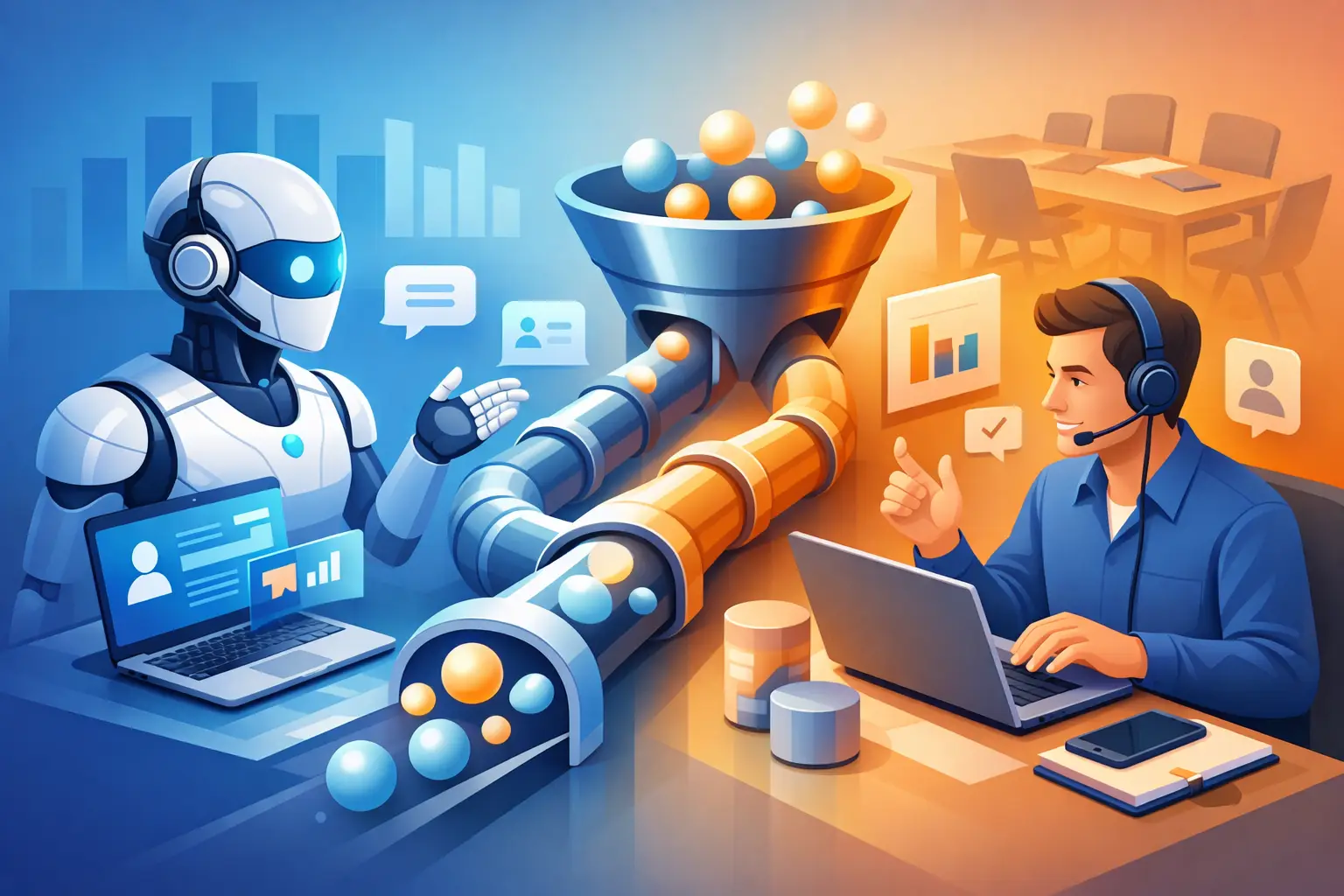
A missed follow-up rarely looks expensive in the moment. It is one prospect who never gets a reply, one demo request that sits overnight, or one lead that goes cold while your team handles higher-priority work. Over a quarter, those gaps become a pipeline problem. The AI sales agent vs SDR decision comes down to one question: do you need more human judgment, more consistent sales activity, or both?
For most growing companies, the answer is not about picking a side based on hype. It is about assigning the right work to the right resource. An AI sales agent can run high-volume outreach, respond instantly, qualify interest, and book meetings around the clock. A human SDR can build relationships, handle ambiguity, and navigate conversations where trust and context matter most.
AI Sales Agent vs SDR: The Core Difference
An SDR is a person responsible for prospecting, qualifying leads, and moving potential buyers into booked meetings. They research accounts, write outreach, call prospects, follow up, and pass qualified opportunities to an account executive or founder. A strong SDR can create real momentum. But that output depends on hiring quality, onboarding, management, incentives, and daily execution.
An AI sales agent is an automated revenue operator built to execute specific sales development workflows. Depending on its configuration, it can identify and enrich target accounts, personalize outbound messages, manage multichannel follow-up, answer common questions, qualify prospects against defined criteria, and schedule appointments directly on a calendar.
The distinction is not that one sends messages and the other does not. Both can do that. The difference is operational capacity. An SDR has a finite workday and a finite number of quality touches they can manage. An AI agent can maintain a defined outreach process continuously, without losing track of a lead because the day got busy.
Where AI Sales Agents Create the Biggest Advantage
AI agents are strongest when your sales process has repeatable steps and speed matters. This is common in B2B services, agencies, SaaS, recruiting, local service businesses, and real estate. If your team already knows the target buyer, the offer, the qualification criteria, and the next step, automation can take over a large share of the execution.
Consistent outreach without the management burden
Manual SDR teams require more than salary. They need recruiting, ramp time, call coaching, messaging reviews, performance management, sales tools, and backup coverage when someone leaves. For a small business, that overhead can easily outweigh the value of adding a single junior hire.
An AI sales agent is designed to create consistent activity from day one of a well-built campaign. It does not need motivation, commission plans, or repeated reminders to complete follow-up sequences. It operates according to the campaign rules, lead criteria, messaging, and scheduling logic you set.
That matters when pipeline has been inconsistent because outreach is treated as work people will get to after serving clients, closing current deals, or handling operations. In those environments, prospecting is not usually failing because the team lacks talent. It is failing because there is no protected capacity.
Faster response and 24/7 availability
Speed-to-lead has a direct effect on conversion. A prospect who responds to outreach or submits an inquiry is most engaged at that moment. Waiting until the next business day gives competitors time to respond first and gives the prospect time to move on.
AI agents can acknowledge interest, ask qualification questions, provide relevant next steps, and offer calendar availability immediately. For real estate teams, this can mean capturing inquiries on evenings and weekends instead of letting them sit until a broker is available. For B2B teams, it means a positive reply can turn into a scheduled discovery call while intent is still high.
Scale at a lower marginal cost
An SDR can only research, contact, and follow up with so many prospects without quality dropping. Scaling a human team usually means adding headcount and management layers. Scaling an AI-driven outbound operation means expanding the right data, targeting, campaign capacity, and oversight.
This does not mean automation makes strategy free. You still need a clear ideal customer profile, compliant outreach practices, deliverability monitoring, and messaging that sounds relevant to the buyer. But once the engine is working, it can increase activity without the same cost curve as hiring more SDRs.
Where a Human SDR Still Wins
Replacing every sales conversation with automation is a mistake. A human SDR remains valuable when the work depends heavily on nuance, relationship-building, or real-time problem solving.
Complex enterprise sales are a clear example. If a buyer has multiple stakeholders, a long buying cycle, a sensitive internal change process, or highly technical questions, a skilled person can read the room in ways automation cannot fully replicate. Human SDRs are also better positioned to handle a skeptical executive, reframe a difficult objection, or identify an opportunity that does not fit the original qualification script.
A human touch can also be critical when trust is the product. High-ticket advisory services, strategic partnerships, and relationship-driven industries often benefit from personal outreach early in the process. The buyer may be evaluating the quality of the person behind the offer as much as the offer itself.
The practical point is not that humans are better or AI is better. It is that human effort is expensive, so it should be focused where judgment changes the outcome. Asking an experienced SDR to spend hours copying data, sending routine reminders, or chasing a calendar link is not a high-value use of their time.
Cost, Control, and Risk: The Real Trade-Offs
The comparison gets clearer when you look beyond activity volume.
| Factor | AI Sales Agent | Human SDR | |---|---|---| | Availability | Runs continuously based on campaign rules | Limited to working hours and coverage | | Cost structure | Lower, more predictable software and service cost | Salary, benefits, tools, training, and management | | Follow-up | Consistent and immediate | Can be excellent, but varies by workload | | Judgment | Works within defined instructions and data | Handles ambiguity and complex conversations | | Scalability | Expands with campaign volume and systems | Requires additional hiring and ramp time |
Control matters on both sides. With an AI agent, the risk is poor setup. Weak targeting, generic copy, outdated data, or unclear qualification rules will create poor outcomes faster. Automation amplifies the process you give it. If the process is thoughtful, it creates leverage. If the process is sloppy, it creates more noise.
With a human SDR, the risk is inconsistency. Even a capable rep can have uneven weeks, lose focus, leave the company, or struggle to maintain a disciplined follow-up cadence while juggling competing priorities. Management can reduce that risk, but management is another cost.
The Best Model for Many Teams: AI First, Human at the Moment of Value
For many small and mid-sized businesses, the most efficient model is not AI or SDR. It is AI for repetitive execution and humans for high-value conversations.
Let the agent build and maintain outreach volume, engage early responses, ask initial questions, route qualified prospects, and book meetings. Then let founders, closers, account executives, or experienced SDRs take over when a live conversation requires expertise. This structure protects human time for discovery, objection handling, relationship development, and closing.
It also changes how you measure sales development. Instead of measuring an SDR only by dials or emails sent, measure the system by qualified conversations, show rates, pipeline created, and revenue influenced. Activity is useful only when it produces movement toward a sale.
Apps2Grow approaches this as a revenue operations problem, not a chatbot experiment. Systems such as Pipeline Pilot are built to handle the prospecting and appointment-setting work that often gets delayed, skipped, or buried under manual sales tasks. The goal is simple: put more qualified meetings on the calendar without building a heavier sales payroll.
How to Decide What You Need Right Now
Choose an AI sales agent first when you have a defined offer, a recognizable target market, and a need for more reliable outreach and follow-up. It is particularly effective if your current bottleneck is lack of activity, slow response times, inconsistent lead nurturing, or the cost of hiring dedicated prospecting staff.
Prioritize a human SDR first when every prospect needs deep research, conversations are highly customized, or your offer requires substantial education before a meeting can be booked. You may also need human support if your market is narrow and each account is valuable enough to justify high-touch outreach.
Start by auditing the last 30 days of lead activity. Look for leads that received no response, prospects that were contacted once and forgotten, meetings that were never offered, and follow-ups that depended on someone remembering. Those are not minor process issues. They are the exact places where a well-configured AI sales agent can turn lost attention into booked opportunities.
The strongest sales team is not the one with the most people or the most automation. It is the one that makes every prospect feel timely, relevant, and properly handled while reserving human attention for the conversations that actually need it.