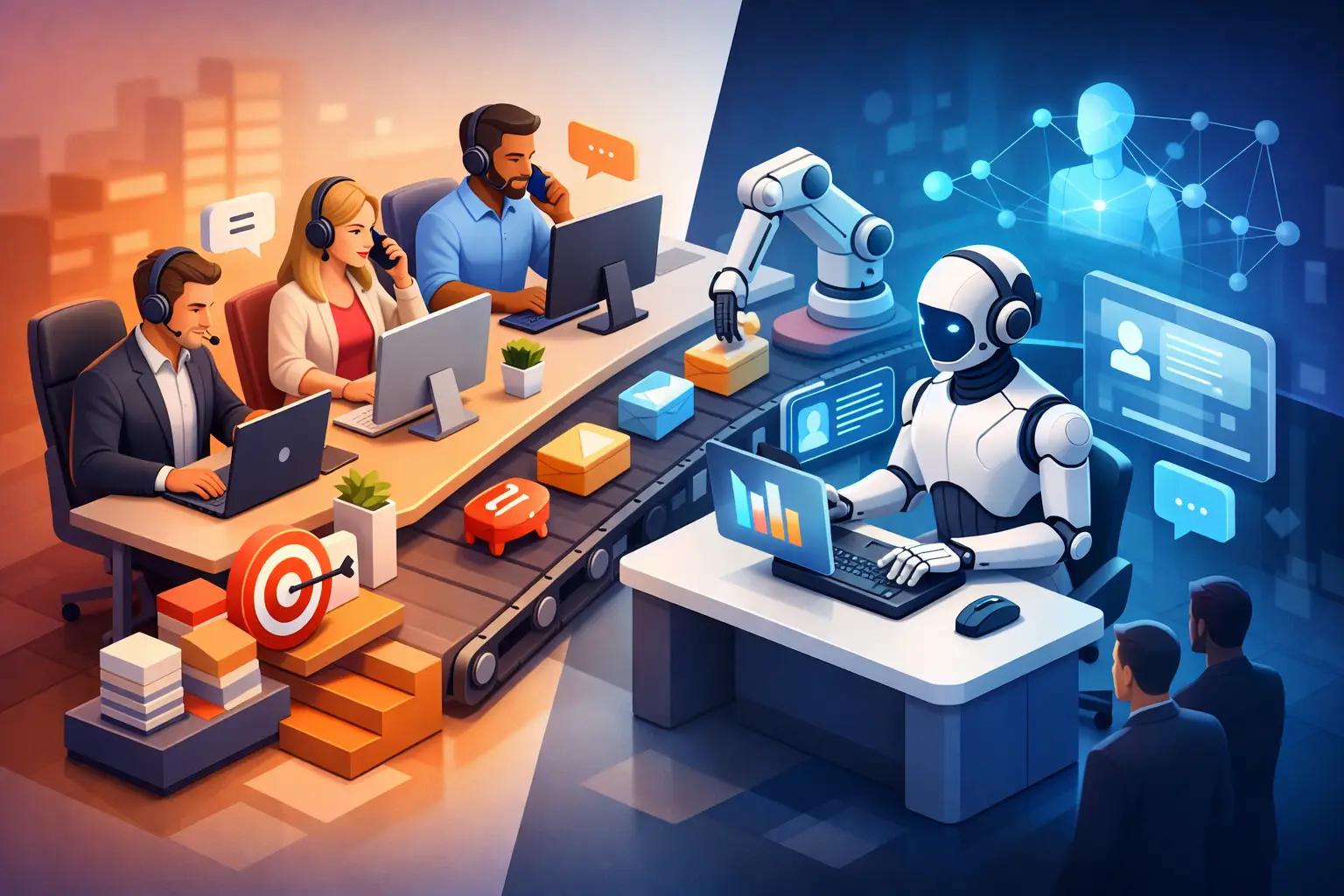
A missed follow-up rarely looks expensive in the moment. It is one prospect who does not get a reply, one inbound lead that waits until Monday, one demo request that sits in a shared inbox. Multiply that across a month, and the cost is not just missed activity. It is pipeline that never had a chance to exist. That is why founders and sales leaders are asking: can AI replace SDR teams?
For many businesses, AI can replace a large share of traditional SDR work. It can research accounts, personalize outreach at scale, respond instantly, follow up consistently, qualify basic fit, and book meetings around the clock. But replacing the work is different from replacing every person. The strongest sales organizations use AI to remove repetitive execution first, then keep humans focused on deals where judgment, trust, and commercial skill matter most.
Can AI Replace SDR Teams for Outbound?
If your SDR team spends most of its day building lists, writing first-touch emails, sending follow-ups, updating CRM fields, and chasing calendar confirmations, the answer is often yes. Those are process-heavy tasks with clear rules, high volume, and little room for inconsistency. They are exactly where agent-based automation creates leverage.
An AI outbound system does not get tired after 80 calls or lose track of a prospect after the third touch. It can run predefined campaigns, adapt messaging based on replies, route qualified conversations, and keep working after business hours. For a lean startup, agency, or real estate operation, that can mean the difference between sporadic prospecting and a reliable meeting pipeline.
The financial case is straightforward. Hiring SDRs involves recruiting, salary, commissions, ramp time, training, management, software, and turnover. AI agents can handle a much larger share of outreach activity without adding equivalent headcount. The goal is not lower cost for its own sake. The goal is more qualified sales conversations per dollar spent.
Still, automation only performs as well as the strategy behind it. AI cannot rescue a weak offer, a vague ideal customer profile, or a broken handoff process. It will simply execute those problems faster.
What AI Sales Agents Can Handle Better Than Manual SDR Work
AI is especially effective when speed and consistency drive results. Lead response is the clearest example. A prospect who submits a form, replies to an email, or asks about availability should receive an appropriate response within minutes, not when someone gets back to their desk. Fast engagement protects intent and improves the odds of booking the conversation.
AI agents also excel at persistent, multi-step follow-up. Most teams do not lose opportunities because their salespeople lack talent. They lose them because follow-up becomes uneven when the team is busy. An agent can maintain cadence across email, text, chat, and scheduling workflows without forgetting who needs the next message.
Account research and list preparation are another strong fit. Instead of asking an SDR to spend hours sorting leads and copying details between tools, an AI system can identify likely-fit prospects based on firmographic, role, location, and behavioral signals. The human seller enters the process with context rather than a blank page.
For businesses with straightforward qualification criteria, AI can also filter early-stage interest. A real estate appointment system, for example, can ask about location, timeline, budget range, and property type before putting time on a broker's calendar. That protects the calendar from low-intent conversations while ensuring serious prospects are handled quickly.
Apps2Grow approaches this as a revenue operation, not a generic chatbot exercise. Systems such as Pipeline Pilot are built to keep outbound prospecting, prospect engagement, and demo booking moving without the daily friction of manual SDR execution.
Where Human SDRs Still Earn Their Place
Replacing an SDR team completely is not always the right move. The higher the deal value, the more complex the buying committee, and the more customized the sale, the more human involvement still matters.
A human seller is better positioned to navigate political risk inside an account, hear hesitation that is not stated directly, and adjust a conversation when the buyer changes direction. Enterprise selling often requires relationship building across multiple stakeholders, careful discovery, commercial negotiation, and credibility earned over time. AI can support those motions, but it should not be left alone to run them.
There is also a brand-risk consideration. Poorly configured automation can sound generic, send messages at the wrong time, or continue outreach after a prospect has clearly opted out. That creates the exact kind of noise buyers dislike. AI does not eliminate the need for quality control. It raises the standard for it.
The practical question is not whether a person can do the job better in theory. Of course they can in many situations. The question is whether you need a person performing every task in the workflow. Paying human labor to copy data, send routine reminders, and schedule meetings is rarely the highest-value use of a sales team.
The Best Model Is Usually AI-First, Human-Backed
For most small and mid-sized businesses, the right answer is not an all-human team or an all-AI system. It is an AI-first sales development model with humans deployed at high-value moments.
AI handles list building, first-touch outreach, rapid response, qualification questions, reminders, rescheduling, and nurture sequences. A founder, account executive, broker, or closer steps in when the prospect meets defined criteria and is ready for a real sales conversation. This keeps expensive human attention focused on discovery, solutions, objections, and closing.
That model also makes capacity easier to manage. A traditional SDR team must be hired ahead of demand and managed through ramp periods. An AI system can support more campaign volume, more follow-up, and more geographic coverage without waiting for a new rep to become productive. When demand grows, the process scales before payroll does.
How to Decide What to Automate First
Start with the work that is repeated most often and measured most clearly. Look at your sales process and identify where leads wait, where reps perform the same actions every day, and where opportunities disappear because nobody followed up.
For many companies, the first automation opportunity is inbound lead response and appointment booking. These workflows have immediate revenue impact and clear success metrics: response time, contact rate, booked meetings, show rate, and qualified-opportunity rate. Once those are stable, expand into outbound sequencing and lead nurture.
Set qualification rules before activating an AI agent. Define your ideal customer, the minimum information required for a meeting, the questions that disqualify a lead, and the moment when a human should take over. Without these guardrails, your calendar may fill with activity that looks productive but does not produce revenue.
Measure outcomes beyond email opens and reply volume. The metrics that matter are qualified meetings held, pipeline created, conversion to opportunity, sales cycle speed, and cost per booked meeting. AI should be held to the same commercial standard as an SDR team.
Avoid the Common Automation Mistakes
The first mistake is treating AI as a message generator rather than a sales system. Writing hundreds of emails is easy. Reaching the right people with a relevant offer, a credible reason to respond, and a disciplined follow-up path is the real work.
The second is automating before positioning is clear. If your pitch changes every week, your target market is too broad, or your offer has no measurable value, automate the diagnosis first. AI can test messaging quickly, but it needs a solid hypothesis to test.
The third is removing human review too early. Review live conversations, rejected replies, booked calls, and no-shows during the first weeks. These signals reveal whether your qualification logic and messaging match the market. The system should improve from real sales feedback, not operate unattended.
Build a Sales Engine That Does Not Depend on Heroics
The traditional SDR model was built around human capacity: how many accounts a rep could research, how many messages they could send, and how consistently they could follow up. AI changes that constraint. Sales development can now operate with more speed, coverage, and persistence than a small team can maintain manually.
That does not make people irrelevant. It makes their time more valuable. Let AI carry the repetitive workload, protect every lead with immediate follow-up, and keep your pipeline moving. Then give your best people the conversations that require judgment and the deals worth winning.