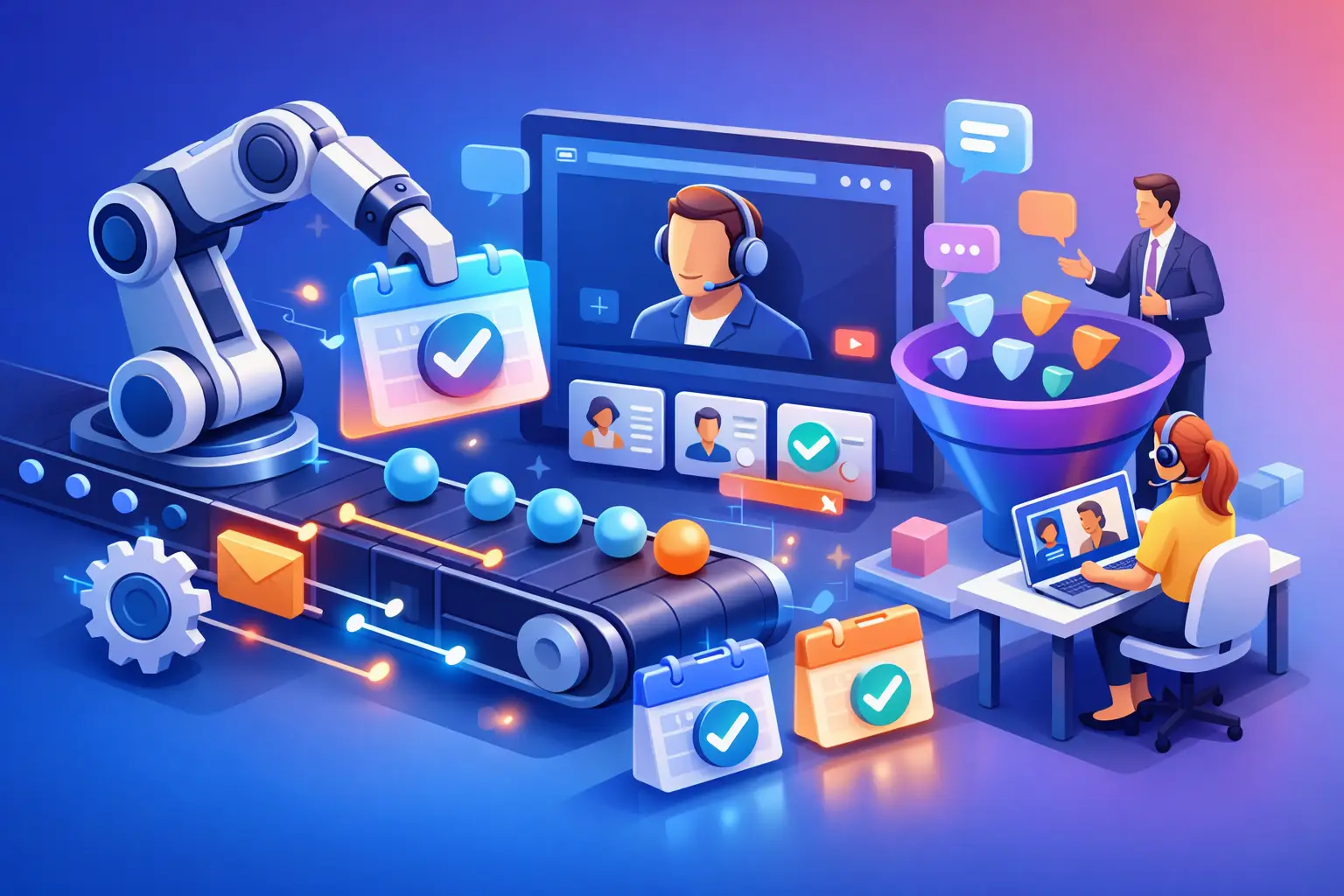
Your calendar should not depend on whether an SDR remembered to send a third follow-up on Friday afternoon. If your team is still manually researching prospects, writing every message, chasing replies, and passing scheduling links back and forth, your pipeline has a capacity problem. Learning how to book demos automatically means building a system that identifies the right buyers, starts relevant conversations, handles routine objections, and schedules qualified meetings without constant human intervention.
The goal is not to automate every sales conversation blindly. The goal is to remove the repetitive work that slows down good salespeople and causes prospects to go cold. Done well, automated demo booking gives your team more conversations with people who have a real reason to buy.
What Automatic Demo Booking Actually Requires
Automatic demo booking is more than adding a calendar link to an outbound email. A calendar link only works after a prospect is interested. The real work happens before that moment: finding the right contact, delivering a relevant message, responding quickly, qualifying intent, and making it easy to choose a time.
A reliable system has five connected parts: a defined ideal customer profile, accurate prospect data, personalized outreach, intelligent follow-up, and calendar scheduling tied to qualification rules. If one part is weak, the rest of the system has to compensate.
For example, a great AI agent cannot rescue a poor target list. If you reach out to companies that do not fit your offer, you may generate replies but not worthwhile demos. Likewise, a strong list will underperform if follow-up is slow or generic.
The advantage of agent-based automation is continuity. Rather than treating lead research, outreach, reply handling, and scheduling as separate tasks, the system operates like a revenue operator. It keeps working when your team is in meetings, after business hours, and when manual follow-up usually slips.
How to Book Demos Automatically in Five Steps
1. Define what a qualified demo looks like
Before automating outreach, decide who should get on a sales call. This sounds obvious, but many teams optimize for meeting volume and then wonder why closers are stuck with poor-fit demos.
Set clear qualification criteria based on company type, size, location, role, pain point, buying trigger, and budget potential. A B2B SaaS company may want founders or sales leaders at companies with a certain headcount. A real estate professional may prioritize leads in a specific market who are actively looking to buy, sell, or invest.
Keep the criteria practical. If your definition requires ten data points that are hard to verify, automation becomes fragile. Start with the signals that actually correlate with closed business.
You should also decide which conversations can book directly and which need an extra qualification step. High-volume, lower-ticket offers may allow qualified prospects to schedule immediately. Complex enterprise sales may require the AI agent to collect a few details before offering time with an account executive.
2. Build a prospect list around real buying signals
A large list is not a pipeline strategy. The best automated booking systems focus on people with a plausible reason to care now.
Look for triggers that match your offer. These can include hiring activity, new funding, expansion into a new market, a leadership change, technology adoption, property activity, or a visible gap in the company’s current sales process. The message should connect to something the prospect can recognize, not a vague claim that you can help them grow.
Data quality matters here. Verify contact details, avoid outdated titles, and exclude companies already in your CRM or active customer base. Sending duplicate outreach creates a bad experience and makes your sales operation look disorganized.
For smaller teams, a narrower list with stronger targeting is usually the better trade-off. You may send fewer messages, but the conversations will be more relevant and your booking rate will be easier to improve.
3. Use AI to personalize outreach at scale
Personalization does not mean inserting a first name and company name into the same template. Prospects can spot that immediately. It means connecting your offer to their role, company situation, or likely operational challenge.
An AI outreach agent can research public company information, identify relevant context, and create messages that sound specific without requiring an SDR to write every first touch. The best messages are short, direct, and focused on an outcome.
For example, instead of saying that you offer cutting-edge automation, lead with the business problem: inconsistent pipeline, slow lead response, unworked inbound leads, or the cost of building an SDR team. Then make one clear ask.
Do not over-automate the tone. If every message is overly polished, full of buzzwords, or packed with assumptions, reply rates will suffer. Good outbound sounds like a sharp operator noticed something relevant and reached out with a useful idea.
4. Automate follow-up and reply handling
Most demos are not booked from the first message. They are booked because the follow-up arrived at the right time and kept the conversation moving.
Your system should run a structured follow-up sequence across the channels your buyers actually use. Email is often the foundation, but some audiences respond better when outreach is supported by phone, SMS, or professional social channels. The right mix depends on your market, compliance requirements, and the level of trust needed before a meeting.
Follow-ups should add context, not simply repeat the first request. One message can reference a business outcome. Another can address a common objection, such as lack of internal bandwidth or concern about adding more software. A final message can give the prospect an easy way to close the loop.
This is where AI agents create real leverage. They can recognize positive interest, answer basic questions, route complex objections to a human, and continue the conversation without waiting for someone to check an inbox. Speed matters. A prospect who replies at 8:30 p.m. is far more likely to book when they get a helpful response quickly than when they hear back the next morning.
5. Connect qualification to calendar scheduling
When a prospect is ready, friction should disappear. The system should offer available meeting times, confirm the appropriate meeting type, and place the event on the right salesperson’s calendar.
Build simple routing rules. Route based on territory, company size, product interest, deal potential, or availability. Include calendar buffers so reps are not booked into back-to-back calls all day. Send reminders to reduce no-shows, and make rescheduling easy rather than forcing prospects to start over.
Not every booked meeting is a win. Track attendance, qualification rate, opportunity creation, and revenue after the demo. If a campaign produces many bookings but few qualified opportunities, adjust the targeting or qualification prompts. The point is productive calendar volume, not vanity metrics.
Where Teams Get It Wrong
The most common mistake is automating a broken process. If your offer is unclear, your targeting is broad, or your sales team does not follow up after a meeting, adding automation only increases the volume of weak activity.
Another mistake is treating every lead the same. A founder at a 20-person company and a VP of Sales at a 500-person company may share a pain point, but they do not buy the same way. Your messaging, qualification questions, and handoff process should reflect that.
Teams also underestimate deliverability and compliance. Sending high volumes from poorly configured email infrastructure can damage your sender reputation and reduce response rates. Automated outreach needs sensible sending limits, clean data, opt-out handling, and messaging that respects the recipient’s time.
Finally, do not remove humans from the moments where judgment matters. AI can handle repetitive engagement and scheduling, but a skilled salesperson should step in for strategic accounts, nuanced objections, and high-value conversations. Automation creates more selling time. It does not replace the need for a credible sales process.
Measure the Metrics That Lead to Revenue
Track the full path from outbound activity to closed business. Start with deliverability, positive reply rate, and booked demo rate. Then measure show rate, qualified-demo rate, opportunities created, pipeline value, and customer acquisition cost.
These numbers tell different stories. A low reply rate points to targeting or messaging. A strong reply rate with weak booking may mean your call to action is too aggressive or your qualification flow is confusing. Good bookings with poor show rates often signal weak confirmation, insufficient lead intent, or meetings scheduled too far in advance.
Review results weekly, not quarterly. Small adjustments to audience segments, message angles, follow-up timing, and routing rules can materially improve output over a month.
Apps2Grow approaches this as a revenue operation, not a disconnected automation project. Its AI agents are designed to keep prospecting, engagement, and appointment setting moving without requiring a larger SDR payroll.
The practical test is simple: if your team stopped manually chasing leads for a week, would qualified demos still appear on the calendar? Build toward that standard. When your system can consistently create relevant conversations and convert interest into scheduled meetings, your sales team can spend its time where it has the highest value: turning qualified demand into revenue.